
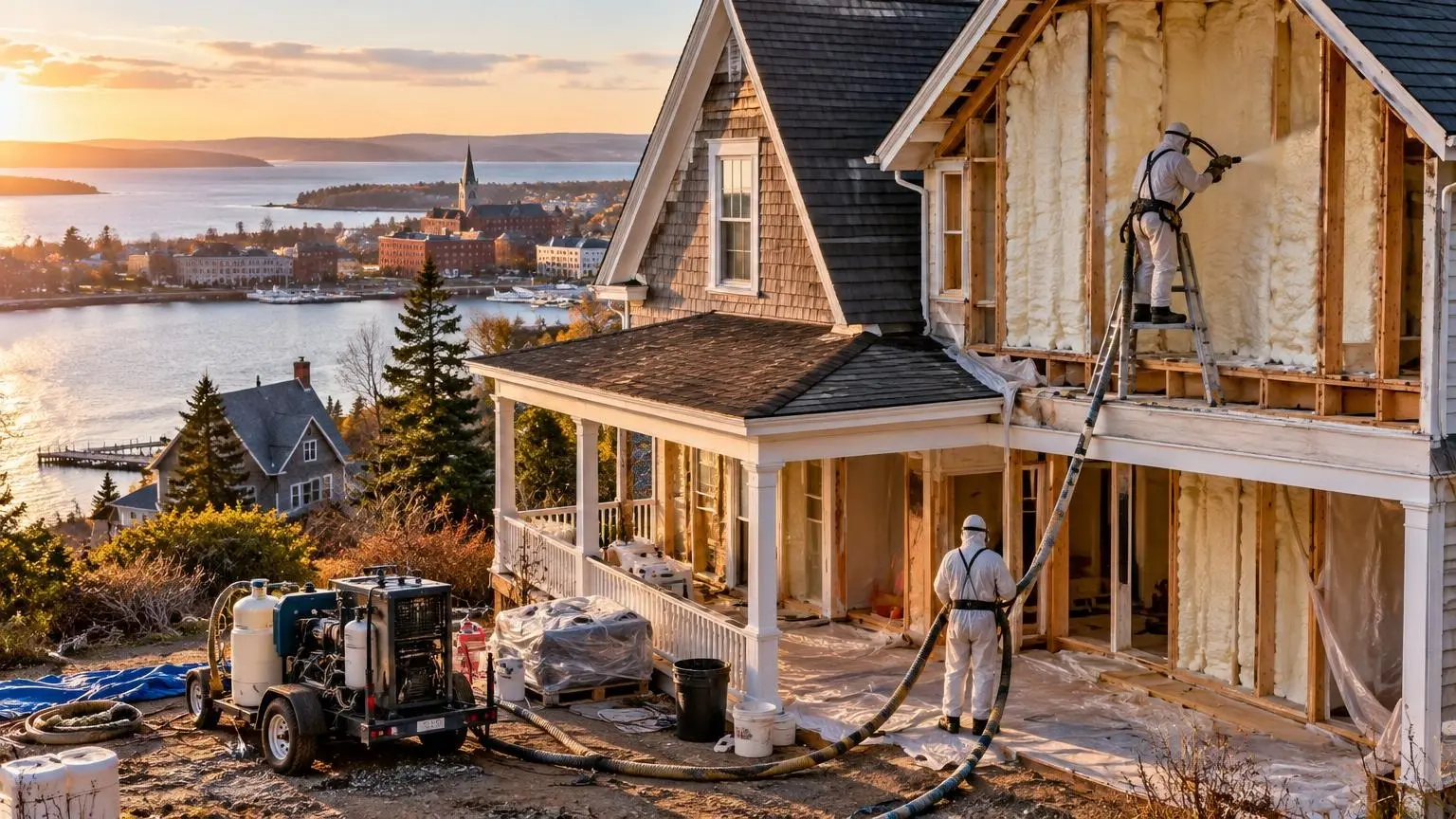
Foam for a Zone 6 winter
Spray Foam Insulation in Traverse City, MI
One layer that stops air and adds R-value, sprayed only where it pays off.
- Free estimates after an on-site look
- Every area listed with material, thickness and R-value
- Roof leaks, wet framing and old wiring pointed out before we cover them
Why Foam Works in Cold Country
Spray Foam Insulation is applied as a two-part liquid that expands and cures into a solid layer bonded to the framing, concrete or steel behind it. It fills cracks and seams completely, so it stops air movement while it insulates. That matters in northern Michigan, where wind off the bays and long stretches below freezing pull cold air in at the bottom of a house and push warm air out the top. Batts and loose fill slow heat; foam also stops the air carrying it.
Closed-cell foam
Dense and rigid when cured, closed-cell foam rates about R-5 to R-7 per inch according to HomeGuide. At normal thickness it slows water vapor and will not absorb water. That makes it our choice for rim joists and sills, foundation and crawl space walls, the underside of cottage floors, cathedral ceilings and roof decks without an attic, and the steel of pole barns. A few inches add a lot of R-value in a tight spot.
Open-cell foam
Open-cell foam is light and spongy, about R-3.5 to R-3.8 per inch. It expands to fill irregular cavities and dampens sound, so it suits interior walls, floors between levels and some rooflines. It lets vapor through, which in a Zone 6 climate means it needs a vapor retarder or a design that lets the assembly dry, and it should not touch cold concrete or steel.
Cathedral ceilings and lofts
Many northern Michigan homes and cottages have vaulted ceilings, lofts and log or timber accents, with little room for insulation between the rafters. Closed-cell foam packs the most R-value into that shallow space and seals the air leaks that cause ice dams along the eaves. It has to go on a dry roof deck, so we check for leaks first.
Where we would not use foam
An open attic floor is almost always cheaper to seal and blow in to depth. Closed walls in a finished house are usually filled with dense-pack cellulose through small holes. And foam never fixes a leak: roof, plumbing and foundation water problems come first.
The day of the job
We protect floors and contents, ventilate, and spray in passes to the depth on your estimate. HomeGuide advises staying out of the house for at least 24 hours while foam cures and airs out. In living or storage spaces foam generally needs a thermal or ignition barrier, depending on the product and use, and we include it when it is needed. Foam also needs the surface and the air to be warm enough, so winter jobs in unheated spaces may need temporary heat.
Call (231) 640-5435 or book a visit and we will show you where foam makes sense in your home or cottage. Get a free estimate
What This Covers
Where we spray foam.
Rim joists and sills
Closed cell all around the top of the foundation.
Cathedral ceilings
Closed cell in shallow rafter bays to fight ice dams.
Cottage floors
Closed cell under floors over open crawl spaces or piers.
Crawl space and basement walls
Closed cell on block, poured concrete or stone.
New walls and additions
Open or closed cell in open stud walls.
Pole barns and garages
Closed cell on steel to insulate and stop dripping.
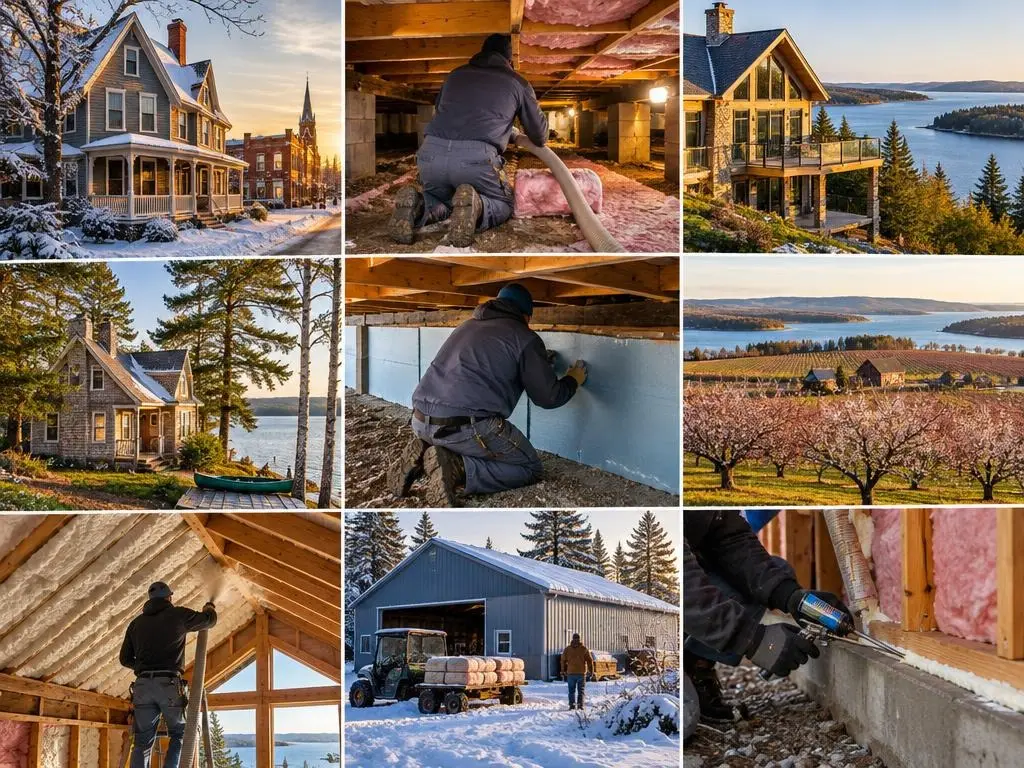
Published Spray Foam Insulation Costs
| Job | Range and source |
|---|---|
| Spray foam, installed | $1.50 to $5.00 per sq ft (HomeGuide) |
| Open-cell / closed-cell | $1.50 to $3.50 / $3.00 to $5.00 per sq ft (HomeGuide) |
| About 1,000 sq ft | $1,500 to $5,000 (HomeGuide); $3,150 to $7,500 existing home (Fixr) |
| Existing walls / new construction | $3.15 to $7.50 / $2.75 to $6.50 per sq ft (Fixr) |
| All exterior walls | $4,000 to $10,000 (HomeGuide) |
| Whole house | $8,000 to $20,000 (HomeGuide); $10,000 to $30,000 (Fixr) |
| Typical job minimum | $1,000 to $2,000+ (HomeGuide) |
National ranges from HomeGuide (2026) and Fixr (2025), shown as a reference. Foam type, depth, access, travel and the job minimum change the total. We measure on site; the price on your written estimate is the price.
How It Works
1. Site visit
We measure each space and check for leaks, wet wood and wiring.
2. Written plan
Foam type, depth, R-value and price for every area.
3. Prep and spray
Masking, ventilation and temporary heat if needed, then foam to depth.
4. Barrier and cleanup
Any required barrier applied, trimmings removed, final walk-through.
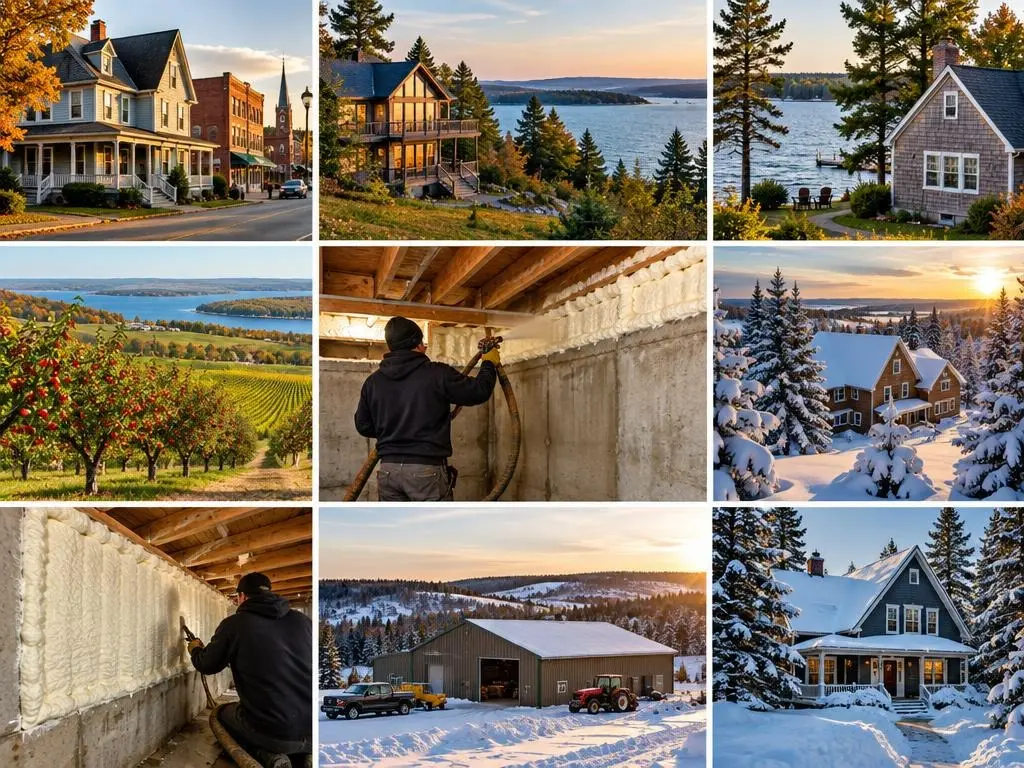
Why Choose Us for Spray Foam Insulation
Foam where it wins
Open attic floors get sealing and blown-in instead.
Depth written down
Every area lists thickness and R-value.
Dry decks only
We check for roof leaks before foaming a roofline.
Spray Foam Insulation Questions
Who manufactures spray foam insulation?
Spray foam systems are made by several chemical manufacturers and sold to installers through distributors. For your house, what matters is the foam type, the thickness and correct mixing and application, all of which we put on the estimate.
Can spray foam be installed in winter?
Yes, but the surface and air need to be warm enough for the foam to cure properly. In unheated spaces we may use temporary heat.
How long do we stay out after foam?
HomeGuide advises at least 24 hours while it cures and airs out.
Will foam in my cathedral ceiling stop ice dams?
Sealing and insulating a shallow vaulted ceiling with closed-cell foam removes the warm air that melts roof snow, which is the main cause of ice dams there.

Spray Foam Insulation Service Areas
- Spray Foam Insulation in Traverse City, MI
- Spray Foam Insulation in Garfield Township, MI
- Spray Foam Insulation in East Bay Township, MI
- Spray Foam Insulation in Peninsula Township, MI
- Spray Foam Insulation in Elmwood Township, MI
- Spray Foam Insulation in Acme Township, MI
- Spray Foam Insulation in Long Lake Township, MI
- Spray Foam Insulation in Blair Township, MI
- Spray Foam Insulation in Elk Rapids, MI
- Spray Foam Insulation in Suttons Bay, MI
- Spray Foam Insulation in Leland, MI
- Spray Foam Insulation in Interlochen, MI
- Spray Foam Insulation in Kingsley, MI
- Spray Foam Insulation in Kalkaska, MI
Get a Spray Foam Insulation Estimate
Free spray foam estimates in the Traverse City area.